Kraków Forum on AI in Education · From Research to School Practice(Krakowskie Forum AI w Edukacji)UKEN, ul. Ingardena 4, room 101N · 24 November 2026, 12:00
How to prepare complete courses with AI?
An agentic workflow shown on four complete courses: Claude Code as the instructor’s technical assistant
Dr. Bartosz NaskręckiFaculty of Mathematics and Computer ScienceAdam Mickiewicz University in Poznań
Slides, PDF, full text (Polish and English):bnaskrecki.faculty. wmi.amu.edu.pl/uken2026/en
0 Thesis
The instructor designs, the agent builds, verification decides
🧭
Instructor
goal · content · decisions
the course path and its intellectual ambition
choice and depth of examples
grading rules, deadlines
what we publish, and when
⚙️
Agent (Claude Code)
code · pages · formats
slides, book, applets, website
Moodle tasks with variants
formatting, translation, publishing
documentation: plan, journal, memory
✅
Verification
computation · tests · checks
numbers computed at every build
task tests that reject typical mistakes
checks of links, layout and language editions
history of changes in git
The agent lifts from the instructor the need for expert programming knowledge. The time that is freed goes into the course plan, sophisticated examples and a detailed treatment of the content.
B. Naskręcki · How to prepare complete courses with AI? · Kraków Forum on AI in Education · UKEN, 24 Nov 202602 / 23
1 Four complete courses · February–November 2026
One workflow, four courses, five model versions
/nnets
WMI UAM · Feb–May 2026
Classical Foundations of Artificial Neural Networks
45 chapters in Python + 24 in SageMath · 9 applets (Enigma, Rejewski, Zygalski…) · skeleton in 1 day, then an audit
Opus 4.6–4.8
/vietnam2026
VIASM, Hanoi · Jul–Aug 2026
Automatic Theorem Proving
6 lectures · in-browser labs (Lambda Lab, Peano Lab) · 532 notes in the knowledge base
325 commits, 43 with a Claude trailer · Fable 5, Opus 4.8
/math-comp
WMI UAM · winter 2026/27 · ongoing
Computer-Aided Mathematical Problem Solving
2 lectures + 6 drafts · 4 deep dives · 2 Moodle modules · English edition
60 commits · Opus 5.5
Opus 4.6 · FebOpus 4.7Opus 4.8Fable 5Opus 5.5 · Nov
Numbers counted on 24 Nov 2026 in the course repositories (git log, files); models — from the commit trailers Co-Authored-By: Claude …. Fourth course: Komputerowe rozwiązywanie problemów matematycznych, taught in Polish.
B. Naskręcki · How to prepare complete courses with AI? · Kraków Forum on AI in Education · UKEN, 24 Nov 202603 / 23
1 What a “complete course” means
A complete course = eight layers from a single source
1Landing page with a program-computed graphic
2Slides in HTML with notes and timings
3Book: formulas, code executed at build time
4Applets, interactive, in the browser
5Moodle: modules, coding tasks, surveys
6Task review for the instructor
7English edition that tracks the Polish one
8Plan and drafts of the whole semester
Course Komputerowe rozwiązywanie problemów matematycznych (WMI UAM, 2026/27): bnaskrecki.faculty.wmi.amu.edu.pl/math-comp · Moodle and drafts — instructor’s view (not public).
B. Naskręcki · How to prepare complete courses with AI? · Kraków Forum on AI in Education · UKEN, 24 Nov 202604 / 23
1 Choosing the tools
A paid model + free tools on your own computer
Paid · model subscription
Claude Codean agent in the terminal or VS Code: reads files, runs programs, writes and tests code
Claude in Chromean agent in the browser — e.g. building tasks in a logged-in Moodle
~/claude/math-comp — 26.10.2026> ! scripts/deploy.shsprawdzanie wydania angielskiego:błędy 0, uwagi 3
sprawdzono 4085 odnośników,brakujących: 0, zagnieżdżonych <a>: 0Transfer starting: 710 files
TipChoose open, text-based formats — Markdown, HTML, Python, LaTeX. The agent can read, write, compare and check them; a closed slide editor shuts it out.
Terminal: a real publishing run of the math-comp course (script output from the session log, 26 Oct 2026; output in Polish: “English edition check: errors 0, notes 3 · checked 4,085 links, missing: 0, nested <a>: 0”).
B. Naskręcki · How to prepare complete courses with AI? · Kraków Forum on AI in Education · UKEN, 24 Nov 202605 / 23
I
Part I Workflow
From an empty folder to a course plan
The opening prompt, project memory, kinds of prompts and the stages of work.
I Opening prompt · 5 October 2026, 03:52
The first prompt: context, products, limits
Instructor → Claude Code · math-comp (translated from Polish)
This project is the portal for the course Komputerowe rozwiązywanie problemów matematycznych, which I teach to second-year mathematics students […]. I am attaching the detailed syllabus document […] 8 meetings (90 minutes each) for the lecture […] exercise classes (15 meetings of 90 minutes). ①
What matters to me is preparing a landing page (Generate the graphic for the landing page), slides for the lecture and exercise sets […] and creating applets. ②
We will model it on the template of the course github.com/nasqret/classical-foundations-ann ③ […] For the materials I want to draw on the content of my course […] ④
An essential element will be interactive tasks in Moodle that require writing code and checking that code. ⑤
I would like the first lecture to explain how such a Computer Algebra System actually works […] and how this differs from a full formal proof, e.g. one compiled in Lean […] ⑥
For now you will publish only the first lecture. Don’t generate the next ones yet. I need to think. ⑦
The documentation should be: memory file · journal file · plan file · Obsidian vault · Jupyter Book · local git repository · private GitHub repository ⑧
1Context: who teaches whom, the syllabus, dates from USOS
2Products: website, slides, labs, applets
3Template: an earlier course as a model for style and structure
4Sources: my own materials from previous years
5Assessment: coding tasks in Moodle
6Intellectual ambition of the first lecture
7Limit: lecture 1 only — “I need to think”
8Documentation: seven artifacts — the same list as for this lecture
Quoted from the Claude Code session log (cuts marked […]; the last line was written in English in the original). Full text: book, chapter “Prompt library” (in Polish).
B. Naskręcki · How to prepare complete courses with AI? · Kraków Forum on AI in Education · UKEN, 24 Nov 202607 / 23
I Project memory
The agent starts every session by reading the plan and the journal
📘
CLAUDE.mdinstructions: hard rules, layout, commands, pitfalls
🧠
MEMORY.mddurable facts and decisions: dates, rules, addresses
📓
JOURNAL.mddated journal — where we left off (1,258 lines)
🗺️
PLAN.mdstatuses and the instructor’s open decisions
book/Jupyter Book: full text with formulas and code
🌿
git + private GitHubevery change described and reversible — 60 commits in six weeks
Instructor · 25 Oct 2026 (translated from Polish)Do 1 and 2. I want to stay close to Richardson’s theorem. No digressions.
Agent’s memory · “feedback” noteRichardson: stay on the theorem — no digressions and no examples from outside the construction of the proof. How to apply: new ideas only as a short proposal, never written into the text unasked.
EffectA decision stated once holds in the weeks that follow — even after the context runs out and in a new session.
Files of the math-comp project (as of 24 Nov 2026); memory note richardson-stay-on-theorem.md (the project’s Claude Code memory).
B. Naskręcki · How to prepare complete courses with AI? · Kraków Forum on AI in Education · UKEN, 24 Nov 202608 / 23
I How I talk to the agent
60 messages in six weeks: six kinds of prompts
1 · opening
…For now you will publish only the first lecture. Don’t generate the next ones yet. I need to think.
once: context, products, limits
2 · content
…the IEEE 754 standard and the details of its implementation, tricks, subtleties. It should be a little gem of a topic, brilliant examples (relatively simple).
the teaching goal and the level, not the technology
3 · subject-matter conversation
Isn’t this example a bit contrived? If we don’t know the triple for n = 114, then we don’t really know the function it encodes, right?
critique and follow-up questions
4 · decision round
– Names in the code: keep them in Polish or translate them? >>> Don’t translate the code or the names.
the agent asks in a list, the instructor answers with “>>>”
5 · steering
Push and deploy. Move slides 20 to the end into lecture 2.
short; publishing only on command
6 · report from class
In question 11 of module 1, one of the students got an error in the task: TypeError… Is the error on the implementation side or the task side?
the feedback loop from students
One in five of the 60 messages (13) has at most three words: “Yes.”, “Continue.”, “Push.” — the agent does the rest of the work on its own, between the questions. All quotes are translated from Polish.
Session log of the math-comp course, 5 Oct–19 Nov 2026 (full list: book, “Prompt library”, in Polish).
B. Naskręcki · How to prepare complete courses with AI? · Kraków Forum on AI in Education · UKEN, 24 Nov 202609 / 23
I Stages of work · the math-comp course
From concept to maintenance: seven stages
1Concepttitle, abstract, syllabus, dates
2Skeletonportal, template, documentation
3Lecture by lecturepublished only on command
4Draft of the wholethe whole semester with deliberate gaps 🚧
full proof of Richardson’s theorem: chapter, PDF, applet
25 Oct
Moodle module 1, task browser, English edition
26 Oct
drafts of lectures 2–8 and labs 4–9
31 Oct
“Pythonic laziness”: 9 parts, measured timings
12 Nov
the circle group: symbolic proofs + applet
18 Nov
lecture 2 fitted to 90 min, Moodle module 2
19 Nov
lecture 2 chapter in the book, Polish and English
The instructor sets the pace: a draft of the whole semester is ready after three weeks, but only what has been taught and approved goes on the website.
Dates from the git history of the nasqret/math-comp repository (60 commits, 5 Oct–19 Nov 2026).
B. Naskręcki · How to prepare complete courses with AI? · Kraków Forum on AI in Education · UKEN, 24 Nov 202610 / 23
II
Part II Content
An ambitious path and sophisticated examples
This is where the time the agent gives back to the instructor goes: the course plan, little gems of topics, auto-research in conversation.
II Planning the course path
Goal: year two at the research frontier, step by step
Instructor · 26 Oct 2026, 00:05 (translated from Polish)The original idea of this course is to show students how language models can be fine-tuned or trained to solve mathematical problems. […] I know it is a fairly ambitious plan, but the idea is to quickly bring students to the frontier of research in this area, and at the same time to show them small projects within their reach.
book/szkice — preview of the whole course (instructor only)
L1 · publishedHow does a computer do mathematics?
L2 · publishedComputer algebra and floating-point numbers
L3 · draftMiniCAS from the inside
L4 · draftFrom Automath to tactics
L5 · draftNumerical methods: picture → CAS → proof
L6 · draftCAS in proofs: Gröbner bases, geometry
L7 · draftGeometry in the style of AlphaGeometry
L8 · draftLanguage models guess tactics
The agent also writes teaching tools that the instructor would not have to know how to program: a λΠ type checker, a small DD+AR geometry engine (16 tests), tactic predictors for Peano Lab proofs.
Prompt of 26 Oct 2026 (excerpt); the plan for lectures L3–L8 is a proposal from the course’s PLAN.md — unpublished drafts (6 decks of 39–46 slides, deliberate gaps 🚧).
B. Naskręcki · How to prepare complete courses with AI? · Kraków Forum on AI in Education · UKEN, 24 Nov 202612 / 23
II Auto-research in conversation · Richardson’s theorem
Exploring sources: the agent proposes, the instructor narrows it down
6 Oct
Instructor (translated from Polish)In the src folder I have notes and Richardson’s original paper. I would like to prepare a solid, step-by-step proof with all the details. […]
Agenta chapter with the full proof (concepts, proof, context, exercises) + a LaTeX/PDF version from the same sources + an applet
22 Oct
Instructor (translated from Polish)Can we build an example of an expression whose vanishing or negativity will be very hard to decide? […] numerics can be very deceptive.
Agent“an expression whose sign you cannot see” — from the equation \(x^3+y^3+z^3=a\); a certificate for \(a=42\) computed when the book is built
25 Oct
Instructor (translated from Polish)Isn’t this example a bit contrived? […] No digressions.
Theorem (D. Richardson, 1968)For expressions built from \(x\), rational numbers, \(\pi\), \(\ln 2\) and the functions \(\sin\), \(\exp\), \(|\cdot|\) by addition, multiplication and composition, there is no algorithm that decides whether a given expression is identically equal to \(0\).
book/richardson/r2_przyklad
Prompts from the session log (excerpts); the chapter “Richardson’s theorem” and its PDF version: bnaskrecki.faculty.wmi.amu.edu.pl/math-comp/book/richardson/ (in English: math-comp/en/book/richardson/). Theorem: J. Symbolic Logic 33 (1968).
B. Naskręcki · How to prepare complete courses with AI? · Kraków Forum on AI in Education · UKEN, 24 Nov 202613 / 23
II A sophisticated example · deep dive “The circle group”
One simple object, five parts of mathematics
Instructor · 12 Nov 2026, 21:08 (translated from Polish)The essence is […] to show students how to elegantly check mathematical proofs with purely symbolic methods. […] It would be great to squeeze as much as we can out of this simple example of a cool algebraic group.
Instructor · 21:48 (translated from Polish)The power of mathematics lies in noticing that such organized abstractions naturally shorten and conceptualize proofs, and also point to entirely new phenomena […]
Five parts: the group axioms as polynomial certificates · Chebyshev from powers of a point · Gauss’s 17-gon · the circle over \(\mathbb{F}_p\) and the Lucas–Lehmer test · the Lie group and dual numbers. From the request (21:08) to publication in Polish and English (22:03) and the applet (22:12): just over an hour.
Prompts of 12 Nov 2026 (excerpts); deep dive “The circle group: purely symbolic proofs”: math-comp/book/okrag/ and the applet “The circle group” (commits of 12 Nov 2026).
B. Naskręcki · How to prepare complete courses with AI? · Kraków Forum on AI in Education · UKEN, 24 Nov 202614 / 23
II Reliability
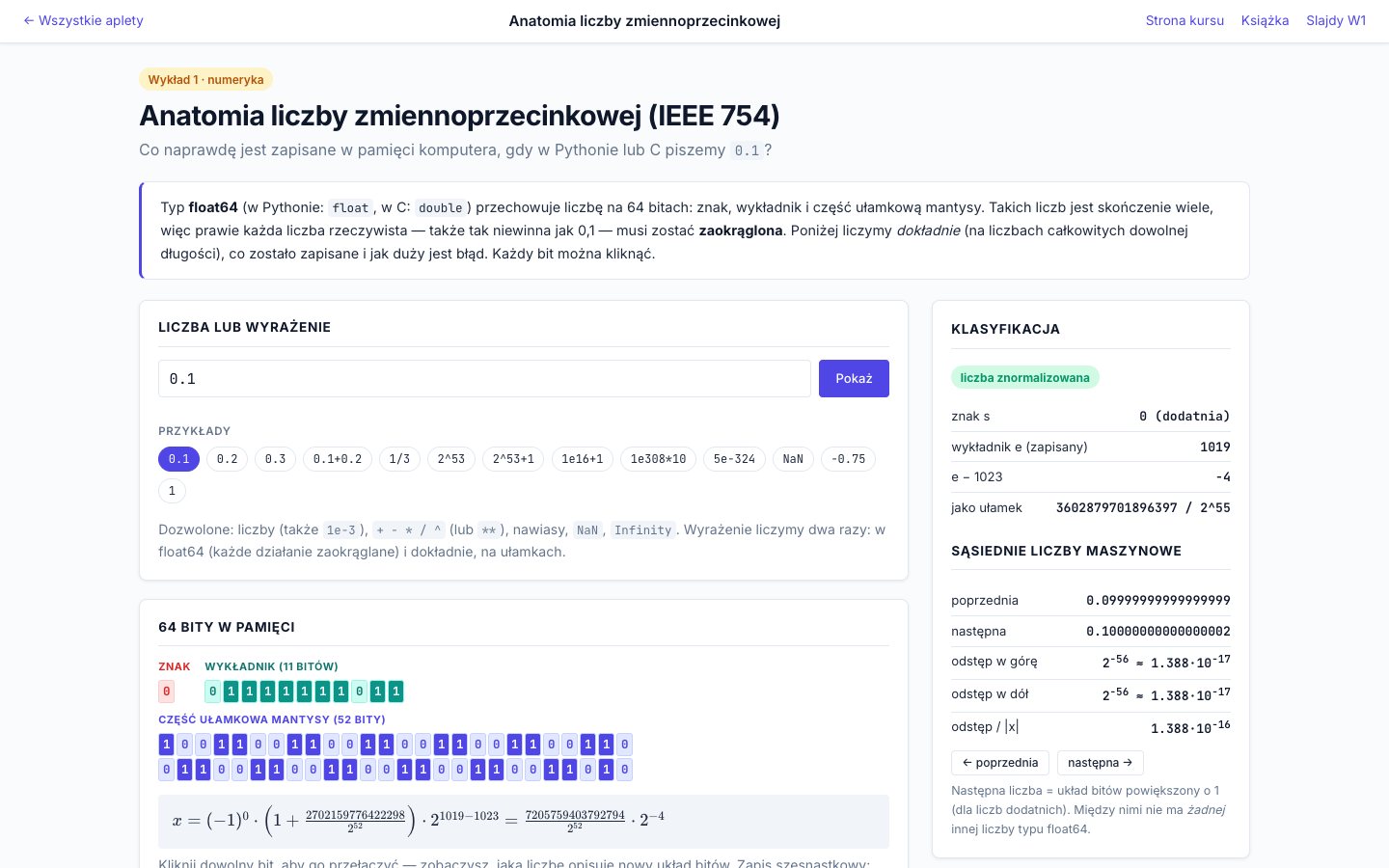
Every number shown to students is computed, not recalled
Every number or output shown to students must be computed, not recalled.CLAUDE.md of the math-comp course · hard rule no. 3
# Python 3.12: pitfalls recorded in the agent’s instructions
>>> sum([0.1] * 10) == 1.0
True# sum() compensates for rounding errors
>>> s = 0.0
>>> for _ in range(10): s += 0.1
>>> s
0.9999999999999999
>>> int(math.exp(math.pi * math.sqrt(163)))
262537412640768256# true value: …743.99…
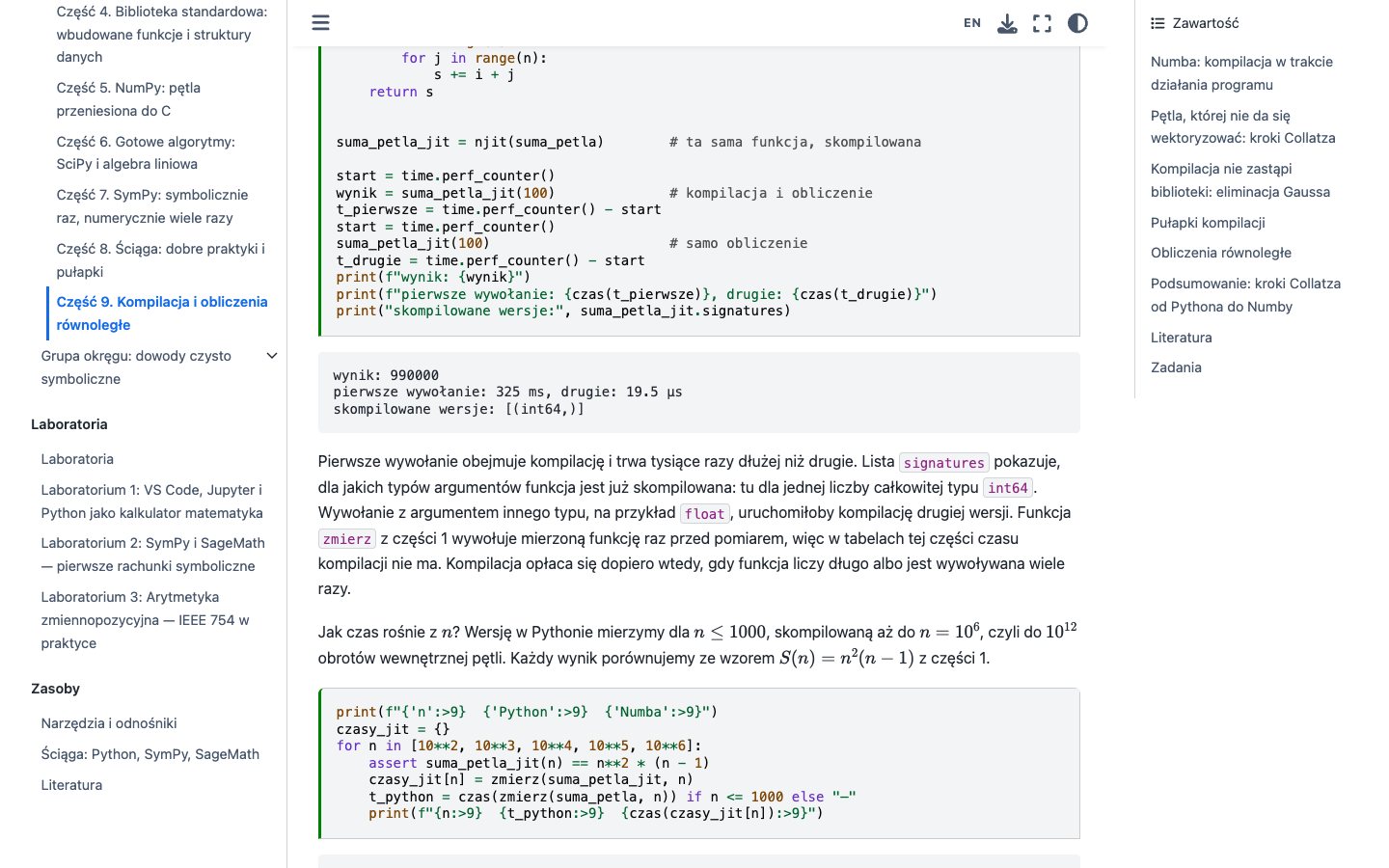
MechanismThe book’s notebooks run at every build. A sentence about running time has a hidden “guard”: if a fresh measurement contradicts it, the build stops.
upewnij(t_timeit < 0.8 * czasy_zakresu[...],
        "%%timeit mierzy pętlę jak w funkcji,
         a nie jak w komórce")
book/python/p9_kompilacja
Results above checked on 24 Nov 2026 (Python 3.12.11); \(e^{\pi\sqrt{163}}=262\,537\,412\,640\,768\,743.99999999999925\ldots\), the spacing of machine numbers at this point = 32. Guard: deep dive “Pythonic laziness”, part 1 (its message, in Polish: “%%timeit measures the loop as in a function, not as in a cell”).
B. Naskręcki · How to prepare complete courses with AI? · Kraków Forum on AI in Education · UKEN, 24 Nov 202615 / 23
II Fitting the slides · lecture 2, 18 Nov 2026
Too much material? Deep dives instead of cuts
Instructor · 18 Nov 2026, 02:31 (translated from Polish)Some of the advanced numerics topics can be moved to topical deep dives. Tomorrow I would like to cover the basics of CAS and numerics, as I planned, but slim down the number of examples, because I have too much of it. Remove the working marks, but mark some of the slides with a deep-dive badge (come up with a nice icon). These topics will only be announced and redirected to the deep dive. Reduce the number of mandatory slides so that I can comfortably fit into 90 minutes.
38slides in the deck
≈ 73mandatory minutes (31 slides) out of 90
7 🤿announcement slides linking to the book
slides_w02.html#/8 — a “🤿 deep dive” slide
Part timings on the plan slide are sums of the timings in the speaker notes — computed, not estimated.
Prompt from the session log; deck slides_w02.html: math-comp/slides_w02.html (in English: math-comp/en/slides_w02.html).
B. Naskręcki · How to prepare complete courses with AI? · Kraków Forum on AI in Education · UKEN, 24 Nov 202616 / 23
III
Part III Moodle and the flow of information
Tasks that check themselves
From the grading specification to Moodle modules, task review and fixes after students’ reports.
III Specification → Moodle · 25 Oct 2026
The instructor writes the rules, the agent builds the modules
Instructor → Claude Code (translated from Polish)
The lab grade will be the sum of the points earned for solving the tasks in 7 modules. […]
1. Knowledge questions: YES/NO, single choice (about 15% of the tasks) […]
2. Computational questions in CodeRunner (about 80% of the tasks) […] on 3 levels (with increasing points). […]
3. Open questions (short answers) as part of a course survey (about 5%). […]
Students may keep solving the tasks until they succeed. […] The computational tasks are individualized (numerically and in small technical details) for each student. […]
I would like you to prepare these tasks by controlling my computer directly in my logged-in Moodle, building all the tasks and testing them. […] For variety, it is worth adding an aesthetic system of colored annotations, frames, etc.
97knowledge questions in the module’s pool (3 drawn)
16CodeRunner tasks: 8 × ★, 5 × ★★, 3 × ★★★
1,662data variants in module 2 — new ones at every attempt
Moodle · description of module 1 (HTML from the generator)
Agent≈ 10.4k lines of generator code in Python: variants, visible and hidden tests, mutants (typical student mistakes that must be rejected), built in Moodle through the Chrome extension.
Prompt of 25 Oct 2026 (excerpts); numbers from the files moodle/modul01, moodle/modul02 in the course repository (24 Nov 2026). Module 1 released on 25 Oct, module 2 built on 18 Nov.
B. Naskręcki · How to prepare complete courses with AI? · Kraków Forum on AI in Education · UKEN, 24 Nov 202618 / 23
III Task review by the instructor
The instructor solves the tasks before the students do
127.0.0.1 · module 1 · task browser (local)
Instructor · 25 Oct 2026 (translated from Polish)Is there a simple way for me to preview all the tasks without touching Moodle? […] I would like you to prepare a version with hints for each task, but so that I can propose the implementation myself. I want to know how hard these tasks are.
the same tests as in Moodle
every variant: step through or draw at random
graded hints: direction → method → key step → pitfalls
estimated time and difficulty, the instructor’s own timer
Tool moodle/przegladarka.py (local server; private — not published on the course website; its interface is in Polish). Screenshot: 24 Nov 2026.
B. Naskręcki · How to prepare complete courses with AI? · Kraków Forum on AI in Education · UKEN, 24 Nov 202619 / 23
III Steering the flow of information
One source, many channels, a feedback loop from students
12 Nov: a student’s TypeError in task 11 of module 1 → “Is the error on the implementation side or the task side?” → diagnosis: a bug in the student’s code (2**(p-1-e) gives a float), the task is correct; adding a hint is the instructor’s call.
The math-comp course: deploy.sh, moodle/kurs/sekcja_ogolna.py, sprawdz_en.py. Report of 12 Nov 2026, without student data; no changes in Moodle (course journal).
B. Naskręcki · How to prepare complete courses with AI? · Kraków Forum on AI in Education · UKEN, 24 Nov 202620 / 23
IV Skills
A skill: a recorded workflow that the agent invokes on its own
.claude/skills/tlumacz-wyklad/SKILL.md---name: tlumacz-wyklad
description: Tłumaczy slajdy i stronę
wykładu PL → EN: struktura, liczby,
terminologia, niuanse języka…
---# Tłumaczenie wykładu
1. Polski jest źródłem; EN w site/en/
2. Kodu, nazw plików, poleceń — nie tłumacz
3. Cytaty promptów: wiernie + „(transl.)”
4. Słowniczek terminów, uwagi tłumacza
5. Kontrola: scripts/sprawdz_en.py
A skill is a folder with instructions (SKILL.md) and materials. The agent loads it when a task matches the description, or on the command /name. The file above is quoted in the original Polish.
seminar-deep-studyown · public
a seminar talk as a deep study of one paper: choosing the topic, a digest, CAS computations, Lean, notes, slides, vault
labyrinth-explorationown · public
open research problems as a labyrinth: a map of what is proved, refuted and still unknown
readbackown
two agents read a formalized proof back into mathematics
agent-mailboxown
a mailbox in files: two agents exchange tasks and verdicts
chrome-browser
an agent in the browser — this is how the modules were built in a logged-in Moodle
tlumacz-patent
the same mechanism in another profession: a skill pack for patent attorneys
tlumacz-wykladnew · this lecture
the English version of these slides and of the website was made with this skill — modeled on the patent skill and on the translation rules of the math-comp course (a glossary of 66 entries)
Skills in ~/.claude/skills/; public: github.com/nasqret/seminar-deep-study, github.com/nasqret/labyrinth-exploration.
B. Naskręcki · How to prepare complete courses with AI? · Kraków Forum on AI in Education · UKEN, 24 Nov 202621 / 23
IV Tips
Eight rules for your first course with an agent
Start with a folder, not a chata project is a folder of files; the agent works on them, git remembers the history
Write a proper opening promptcontext, products, template, sources, limits, documentation
Require project memoryplan, journal, decisions — every session starts by reading them
Talk about the goal, not the technology“a little gem of a topic, simple examples”; formats and code are the agent’s job
Keep the decisions for yourselfgrading rules, dates, what gets published — answer the “to decide” lists
Demand proof of checkingnumbers computed at build time, tasks with tests, checks of links and layout
Separate private from publicsolutions and question banks never go on the website; publish only on command
Aim highspend the time saved on technology on the course path and the depth of the examples
B. Naskręcki · How to prepare complete courses with AI? · Kraków Forum on AI in Education · UKEN, 24 Nov 202622 / 23
Thank you
The instructor designs, the agent builds, verification decides.
This lecture (PL · EN)slides, PDF, full text (Jupyter Book, in Polish), prompt library
Live coursebnaskrecki.faculty.wmi.amu.edu.pl/math-comp